


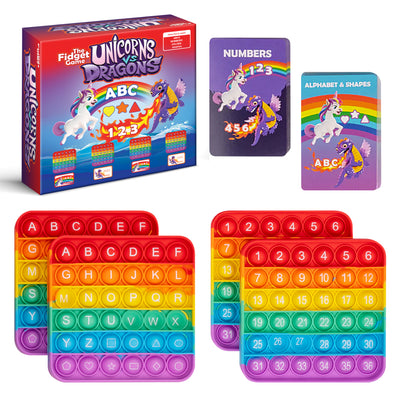
4 Double-Sided Fidget Letter Mats
Educator CreatedDesigned by teachers
30-day returnshassle-free
Secure paymentsSSL encrypted
Ships in 3 daysfrom the US
Unicorns Vs. Dragons!
Unicorns Vs. Dragons!
Regular price
$29.99
Sale price
$29.99
Regular price
$34.99
Unit price
per
What's Inside The Box
Skills Covered After 30 Days
- Identify all letters of the alphabet!
- Master all letter sounds!
- Identify all the colors of the rainbow!
- Master colors and shapes!
- Can count to 36!
- Learn matching skills!
Key Features
- Ages 3+
- 2-4 Players (or 1-on-1 fun)
- Quick & Easy Play (10 min)
Educational Standards
Common Core
- CCSS.ELA-LITERACY.RF.K.1.D Recognize and name all upper- and lowercase letters of the alphabet.
- CCSS.ELA-LITERACY.RF.K.2 Demonstrate understanding of spoken words, syllables, and sounds (phonemes).
- CCSS.MATH.CONTENT.K.CC.A.1 Count to 100 by ones and by tens.
- CCSS.MATH.CONTENT.K.G.A.2 Correctly name shapes regardless of their orientations or overall size.
TEKS
- K.2B.i: identifying and matching the common sounds that letters represent;
- K.2D.v: identifying all uppercase and lowercase letters.
- K.2A: Count forward and backward to at least 20 with and without objects.
- K.6A: Identify two-dimensional shapes, including circles, triangles, rectangles, and squares as special rectangles.
B.E.S.T
- ELA.K.F.1.1.f Identify all upper- and lowercase letters of the alphabet.
- ELA.K.F.1.3.a Demonstrate knowledge of the most frequent sound for each consonant.
- ELA.K.F.1.3.b Demonstrate knowledge of the short and long sounds for the five major vowels.
- MA.K.NSO.2.1 Recite the number names to 100 by ones and by tens. Starting at a given number, count forward within 100 and backward within 20.
- MA.K.GR.1.1 Identify two- and three-dimensional figures regardless of their size or orientation.
Ontario
- K- OE1.1 explore sounds, rhythms, and language structures, with guidance and on their own
- K- OE11.8 demonstrate knowledge of most letters of the alphabet in different contexts
- K- OE15 demonstrate an understanding of numbers, using concrete materials to explore and investigate counting, quantity, and number relationships
- K- OE17 describe, sort, classify, build, and compare two-dimensional shapes and three-dimensional figures, and describe the location and movement of objects through investigation
- Grade 1- B2.2 name and form the upper- and lowercase letters both in and out of order and demonstrate knowledge of alphabetic order, with automaticity
- Grade 1- B2.3 identify, read, and spell most common grapheme-phoneme correspondences of consonants and vowels, with automaticity
BC
- K- Language features, structures, and conventions: concepts of print, letter knowledge
- K- number concepts to 10, single attributes of 2D shapes and 3D objects
- Grade 1- Language features, structures, and conventions: concepts of print, print awareness
- Grade 1- number concepts to 20
Alberta
- K- Children make connections between letters and sounds in words.
- K- Children recognize some letters and words with speed and accuracy.
- Grade 1- Students recognize and analyze letters and sounds in words.
- K- Children investigate shape.
- K- Children investigate quantities to 10.
- Grade 1- Students interpret and explain quantities to 100.
Manitoba
- K: Recognize, apply, and adapt rules and conventions (e.g., form, genre, grammar, register, punctuation, elements of design, spelling, legibility).
- K- K.N.1 Say the number sequence by 1s, starting anywhere from 1 to 30 and from 10 to 1.
- K- Describe the characteristics of 3-D objects and 2-D shapes, and analyze the relationships among them.
New Brunswick
- K- Apply letter-sound knowledge to decode words and simple connected text.
- K- Demonstrate automatic recall of most letter sounds
- K- Sort familiar concrete 3D objects using a single attribute
- K- Describe numbers, ways of representing numbers, relationships among numbers, and number systems.
- Newfoundland & Labrador
- K- GCO 4.5 demonstrate letter knowledge
- K- 1.KN3.2 Recognize and name numerals 1 to 10.
- K- 3.KSS2 Sort 3-D objects using a single attribute and explain the sorting rule.
Nova Scotia
- K- Learners will apply understanding of foundational language knowledge and skill when reading and writing.
- Grade 1- Learners will apply understanding of foundational language knowledge and skill when reading and writing.
- K- K.N01.01 Recite the number sequence from 1 to 20 and from 10 to 1.
- K- 3-D Objects and 2-D Shapes - Students will be describe the characteristics of 3-D objects and 2-D shapes and analyze the relationships among them.
Prince Edward Island
- K- understand basic concepts of print including directionality, word, space, letter, and sound
- K- N.1.1 Say the number sequence by 1s starting anywhere from 1 to 10 and from 10 to 1.
- K- SS.2 Describe the characteristics of 3-D objects and 2-D shapes, and analyze the relationships among them.
Saskatchewan
- K- CCK.2 Use and construct symbols, pictures, and dramatizations to communicate feelings and ideas in a variety of ways.
- K- SSK.2 Sort 3-D objects using a single attribute.
- K- NK.1 Say the whole number sequence by 1s starting anywhere from 0 to 10 and from 10 to 0.
Year 1
- Respond speedily with the correct sound to graphemes (letters or groups of letters) for all 40+ phonemes, including, where applicable, alternative sounds for graphemes
- Name the letters of the alphabet:
- Naming the letters of the alphabet in order
- Using letter names to distinguish between alternative spellings of the same sound
- Count to and across 100, forwards and backwards, beginning with 0 or 1, or from any given number
- Recognise and name common 2-D shapes
Our games are used in 50,000+ classroomsSpecial discounts for school districts and homeschoolers.
Get a Quote


Families Who Have Already Learned to Read
4.95
Skills Built
What skills does Unicorns Vs. Dragons! build?
Letter Sounds
Matching letters to their sounds
Numbers
Counting and recognizing numbers
Geometry
Shapes, space, and patterns
30-Day Money Back Guarantee
How to Play
How to play Unicorns Vs. Dragons!
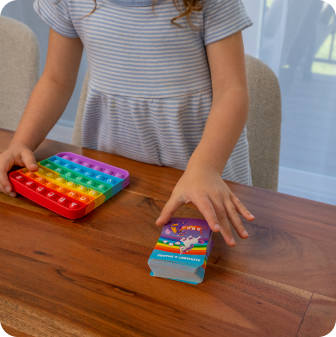
1
Choose your deck—ABCs & Shapes or Numbers?
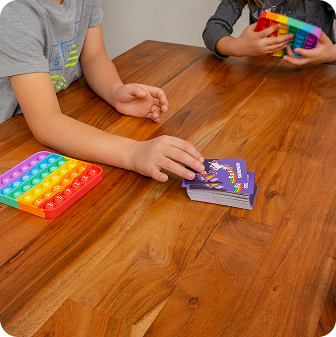
2
Choose a card!
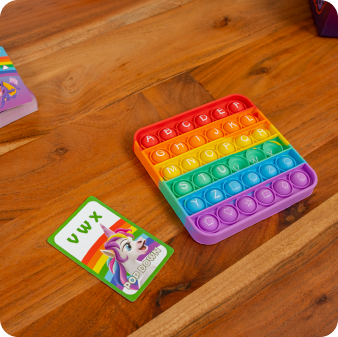
3
Unicorn Card = Pop Bubbles, Dragon Card = Unpop Bubbles
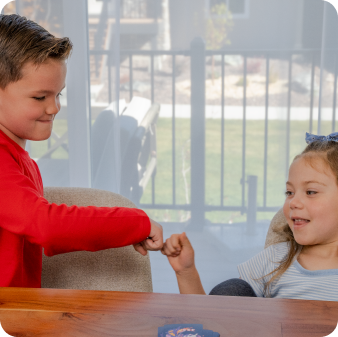
4
Pop all your bubbles to win!
Watch How Unicorns Vs. Dragons! Works


* Results based on internal study with regular users. Individual results may vary.
You ask, we answer!
What is the return policy?
We offer a 30-day return policy for eligible items.