


Grade 3 - 75 cards
Educator CreatedDesigned by teachers
30-day returnshassle-free
Secure paymentsSSL encrypted
Ships in 3 daysfrom the US
Vocabulary Vultures
Vocabulary Vultures
Regular price
$29.99
Sale price
$29.99
Regular price
$34.99
Unit price
per
What's Inside The Box
Skills Covered After 30 Days
- Expand vocabulary knowledge
- Strengthen word comprehension
- Improve communication skills
- Boost reading comprehension
Key Features
- Ages 7+
- 2-4 Players (or 1-on-1 fun)
- Quick & Easy Play (10 min)
Educational Standards
Common core
- CCSS.ELA-LITERACY.L.3.4 Determine or clarify the meaning of unknown and multiple-meaning words and phrases based on grade 3 reading and content, choosing flexibly from a range of strategies.
- CCSS.ELA-LITERACY.L.4.4 Determine or clarify the meaning of unknown and multiple-meaning words and phrases based on grade 4 reading and content, choosing flexibly from a range of strategies.
- CCSS.ELA-LITERACY.L.5.4 Determine or clarify the meaning of unknown and multiple-meaning words and phrases based on grade 5 reading and content, choosing flexibly from a range of strategies.
TEKS
- 3.3A: Use print or digital resources to determine meaning, syllabication, and pronunciation.
- 4.3A: Use print or digital resources to determine meaning, syllabication, and pronunciation.
- 5.3A: Use print or digital resources to determine meaning, syllabication, pronunciation, and word origin.
B.E.S.T
- ELA.3.V.1.1 Use grade-level academic vocabulary appropriately in speaking and writing.
- ELA.4.V.1.1 Use grade-level academic vocabulary appropriately in speaking and writing.
- ELA.5.V.1.1 Use grade-level academic vocabulary appropriately in speaking and writing.
Ontario
- Grade 3- B2.4 demonstrate an understanding of a variety of words, acquire and use explicitly taught vocabulary in various contexts, including other subject areas, and use morphological knowledge to analyze and understand new words in context
- Grade 4- B2.2 demonstrate an understanding of a variety of words, acquire and use explicitly taught vocabulary in various contexts, including other subject areas, and use morphological knowledge to analyze and understand new words in context
- Grade 5- B2.2 demonstrate an understanding of a variety of words, acquire and use explicitly taught vocabulary in various contexts, including other subject areas, and use generalized morphological knowledge to analyze and understand new words in context
BC
- Grade 3- Develop and apply expanding word knowledge
- Grade 3- Use sources of information and prior knowledge to make meaning
- Grade 4- Strategies and processes: reading strategies
- Grade 5- Strategies and processes: reading strategies
Alberta
- Grade 3: Students analyze new words and morphemes to enhance vocabulary.
- Grade 4: Students expand vocabulary and analyze morphemes to communicate in multiple contexts.
- Grade 5: Students analyze how knowledge of vocabulary supports meaning and use of language.
Manitoba
- Grade 3- Be aware of and articulate the ways that one engages with text.
- Grade 4- Be aware of and articulate the ways that one engages with text.
- Grade 5- Be aware of and articulate the ways that one engages with text.
New Brunswick
- Grade 3- Use a range of vocabulary when communicating.
- Grade 4- Use a range of vocabulary when communicating.
- Grade 5- Use a range of vocabulary when communicating.
Newfoundland & Labrador
- Grade 3- Use pictorial, typographical, and organizational features of written text to determine content, locate topics, and obtain information
- Grade 4- Use strategies to make sense of texts
- Grade 5- Use pictures and illustrations, word structures, and text features to locate topics and obtain or verify their understanding of information
Nova Scotia
- Grade 3- Use all sources of information (meaning, structure, visual) to search, monitor, check, and self correct)
- Grade 4- Use and integrate the pragmatic, semantic, syntactic, and graphophonic cueing systems (including context clues; word order; suffixes, compound words, contractions, and singular and plural words) and a variety of strategies to construct meaning
- Grade 5- Use and integrate the pragmatic, semantic, syntactic, and graphophonic cueing systems (including context clues; word order; structural analysis to identify roots, prefixes, and suffixes) and a variety of strategies to construct meaning; use a dictionary to determine word meaning in context
Prince Edward Island
- Grade 3- Use and integrate, with support, the various cueing systems (pragmatic, semantic, syntactic, and graphophonic) and a range of strategies to make meaning
- Grade 4- Use and integrate, with support, the various cueing systems (pragmatic, semantic, syntactic, and graphophonic) and a range of strategies to construct meaning
- Grade 5- Use and integrate the pragmatic, semantic, syntactic, and graphophonic cueing systems (including context clues; word order; structural analysis to identify roots, prefixes, and suffixes) and a variety of strategies to construct meaning; use a dictionary to determine word meaning in context
Saskatchewan
- Grade 3- CC3.2 Communicate ideas and information pertaining to topics, problems, questions, or issues by creating easy-to-follow representations with a clear purpose.
- Grade 4- CC4.2 Create a variety of clear representations that communicate straightforward ideas and information relevant to the topic and purpose, including short, illustrated reports, dramatizations, posters, and other visuals such as displays and drawings.
- Grade 5- CC5.2 Demonstrate a variety of ways to communicate understanding and response, including illustrated reports, dramatizations, posters, timelines, multimedia presentations, and summary charts.
Our games are used in 50,000+ classroomsSpecial discounts for school districts and homeschoolers.
Get a Quote


Skills Built
What skills does Vocabulary Vultures build?
Vocabulary
Learning and using new words
30-Day Money Back Guarantee
How to Play
How to play Vocabulary Vultures
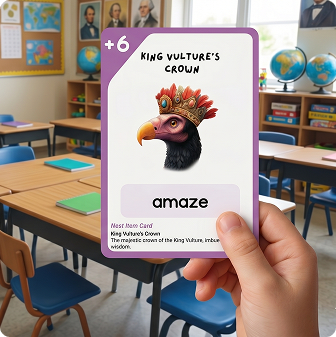
1
Say the word.
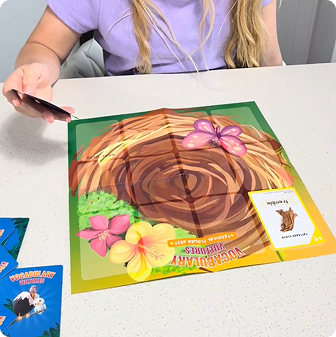
2
Add the card to your nest.
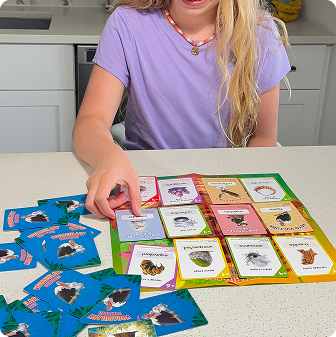
3
Get the most points to win!
Watch How Vocabulary Vultures Works


* Results based on internal study with regular users. Individual results may vary.
You ask, we answer!
What is the return policy?
We offer a 30-day return policy for eligible items.