Skip to product information
1 of 6
Educator CreatedDesigned by teachers
30-day returnshassle-free
Secure paymentsSSL encrypted
Ships in 3 daysfrom the US
Grade 3-5

Word Quest

Word Quest

Regular price $14.99
Sale price $14.99 Regular price $19.99
Save $5.00 | 25% off Sold out
4.91
What's Inside The Box
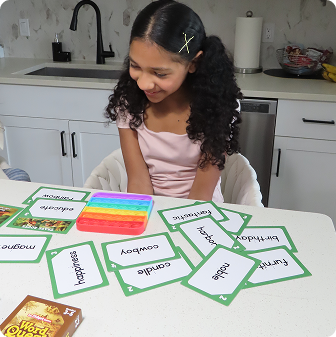
Multisyllabic Words

Multisyllabic Words

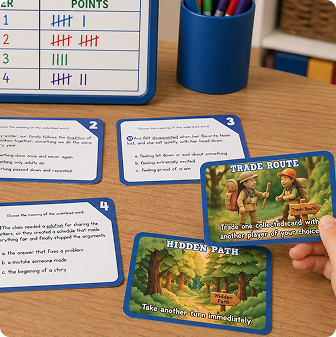
Context Clues and Synonyms

Context Clues and Synonyms

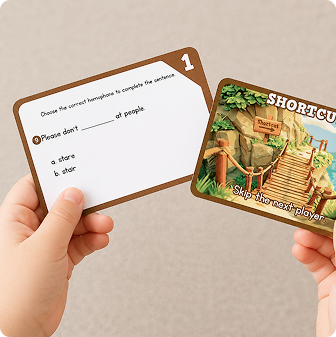
Homophones

Homophones

Skills Covered After 30 Days
  • Strengthens the ability to read and decode multisyllabic words with confidence
  • Builds understanding of homophones by choosing the correct word to complete a sentence
  • Expands vocabulary by identifying synonyms and related word meanings
  • Develops strong context clue skills to determine the meaning of unknown words


Key Features
  • Ages 8 to 11 (Grades 3 - 5)
  • Quick and Easy Play (15 min)
  • Can be used with or without a fidget mat for play.


Educational Standards
Common Core
  • CCSS.ELA-Literacy.RF.3.3 Know and apply grade-level phonics and word analysis skills in decoding words.
  • CCSS.ELA-Literacy.L.3.4.a Use sentence-level context as a clue to the meaning of a word or phrase.
  • CCSS.ELA-LITERACY.RF.4.3 Know and apply grade-level phonics and word analysis skills in decoding words.
  • CCSS.ELA-Literacy.L.4.4.a Use context (e.g., definitions, examples, or restatements in text) as a clue to the meaning of a word or phrase.
  • CCSS.ELA-Literacy.L.4.5.c Demonstrate understanding of words by relating them to their opposites (antonyms) and to words with similar but not identical meanings (synonyms).
  • CCSS.ELA-Literacy.L.4.1.g Correctly use frequently confused words (e.g., to, too, two; there, their).*
  • CCSS.ELA-LITERACY.RF.5.3 Know and apply grade-level phonics and word analysis skills in decoding words.
  • CCSS.ELA-Literacy.L.5.4.a Use context (e.g., cause/effect relationships and comparisons in text) as a clue to the meaning of a word or phrase.
  • CCSS.ELA-Literacy.L.5.5.c Use the relationship between particular words (e.g., synonyms, antonyms, homographs) to better understand each of the words.
BEST
  • ELA.3.F.1.3 Use knowledge of grade-level phonics and word-analysis skills to decode words.
  • ELA.3.V.1.3 Use context clues, figurative language, word relationships, reference materials, and/or background knowledge to determine the meaning of multiple-meaning and unknown words and phrases, appropriate to grade level.
  • ELA.4.F.1.3.a Apply knowledge of all letter-sound correspondences, syllabication patterns, and morphology to read and write unfamiliar single-syllable and multisyllabic words in and out of context. 
  • ELA.4.V.1.3 Use context clues, figurative language, word relationships, reference materials, and/or background knowledge to determine the meaning of multiple-meaning and unknown words and phrases, appropriate to grade level.
  • ELA.5.F.1.3.a Apply knowledge of all letter-sound correspondences, syllabication patterns, and morphology to read and write unfamiliar single-syllable and multisyllabic words in and out of context.
  • ELA.5.V.1.3 Use context clues, figurative language, word relationships, reference materials, and/or background knowledge to determine the meaning of multiple-meaning and unknown words and phrases, appropriate to grade level.
TEKS
  • ELA.3.2.A.ii decoding multisyllabic words with closed syllables; open syllables; VCe syllables; vowel teams, including digraphs and diphthongs; r-controlled syllables; and final stable syllables
  • ELA.3.3.B use context within and beyond a sentence to determine the meaning of unfamiliar words and multiple-meaning words
  • ELA.3.3.D  identify, use, and explain the meaning of antonyms, synonyms, idioms, homophones, and homographs in a text.
  • ELA.4.2.A.ii decoding multisyllabic words with closed syllables; open syllables; VCe syllables; vowel teams, including digraphs and diphthongs; r-controlled syllables; and final stable syllables
  • ELA.4.3.B  use context within and beyond a sentence to determine the relevant meaning of unfamiliar words or multiple-meaning words
  • ELA.4.3.D identify, use, and explain the meaning of homophones such as reign/rain.
  • ELA.5.2A.ii: decoding multisyllabic words with closed syllables; open syllables; VCe syllable; vowel teams, including digraphs and diphthongs; r-controlled syllables; and final stable syllables
  • ELA.5.3.B use context within and beyond a sentence to determine the relevant meaning of unfamiliar words or multiple-meaning words;
Our games are used in 50,000+ classroomsSpecial discounts for school districts and homeschoolers. Get a Quote
View full details
Skills Built

What skills does Word Quest build?

Vocabulary
Learning and using new words
30-Day Money Back Guarantee
How to Play

How to play Word Quest

Watch How Word Quest Works

* Results based on internal study with regular users. Individual results may vary.

You ask, we answer!

How does this align to what my child is learning in school?

The three skill areas in Word Quest — homophones, multisyllabic words, and synonyms and context clues — are core components of upper elementary ELA instruction and are directly tested on standardized assessments in Grade 3–5. These aren't supplemental skills — they're exactly what teachers are working on in the classroom during these years. Word Quest gives students a way to practice those same skills at home in a format that doesn't feel like schoolwork.

What are homophones / multisyllabic words / synonyms and context clues?

Great question — and one your team should be ready to answer confidently:

  • Homophones are words that sound the same but have different meanings and spellings — like there, their, and they're, or to, too, and two. Mastering homophones is a big part of upper elementary reading and writing.
  • Multisyllabic words are words with more than one syllable — like remember, fantastic, or comfortable. Being able to decode and read longer words fluently is a critical skill in Grades 3–5 when texts get significantly more complex.
  • Synonyms and context clues — synonyms are words that mean the same thing, like happy and joyful. Context clues are the words around an unfamiliar word that help a reader figure out its meaning. Both skills are essential for reading comprehension and vocabulary growth.

Can all three card packs be used together in one game?

Yes — and that's one of the things that makes Word Quest especially powerful in a classroom or multi-child household. Students can all be playing the game together while each using the card pack that matches what they need to practice. One student might be working on homophones while another is working on multisyllabic words — they're in the same game, at the same table, but each getting targeted practice in their specific skill area. It's built-in differentiation without anyone feeling singled out.

How is this different from other vocabulary or word games on the market?

Most vocabulary games either feel like flashcards in disguise or are so loosely educational that the learning gets lost in the gameplay. Word Quest is built around specific, standards-aligned skill sets that match exactly what students are working on in Grades 3–5 — so the learning is intentional, not incidental. It's also hands-on and game-based, which means students are actually engaged rather than just going through the motions.

We already have Sight Words — how is this different?

Sight Words is built for K–2 students who are learning to recognize and read high frequency words. Word Quest picks up where that leaves off — it's designed for Grade 3–5 students who already know their basic sight words and are ready to tackle more complex vocabulary and language skills. Think of it as the next chapter. If your child has outgrown Sight Words, Word Quest is exactly what comes next.

We already have King Komodo — do we need this too?

They work together, not against each other. King Komodo focuses on high frequency words — building the word recognition foundation that fluent readers need. Word Quest goes deeper into vocabulary and language — homophones, multisyllabic words, synonyms and context clues. Together, they give Grade 3–5 students a complete word study toolkit. If your child loves King Komodo, Word Quest is the natural next add to keep the learning growing.

What is the return policy?

We offer a 30-day return policy for eligible items.