Skip to product information
1 of 7
Educator CreatedDesigned by teachers
30-day returnshassle-free
Secure paymentsSSL encrypted
Ships in 3 daysfrom the US
Grade 1 Grade 2 Grade 3-5

Fraction Food Frenzy

Fraction Food Frenzy

Regular price $34.99
Sale price $34.99 Regular price $39.99
Save $5.00 | 12% off Sold out
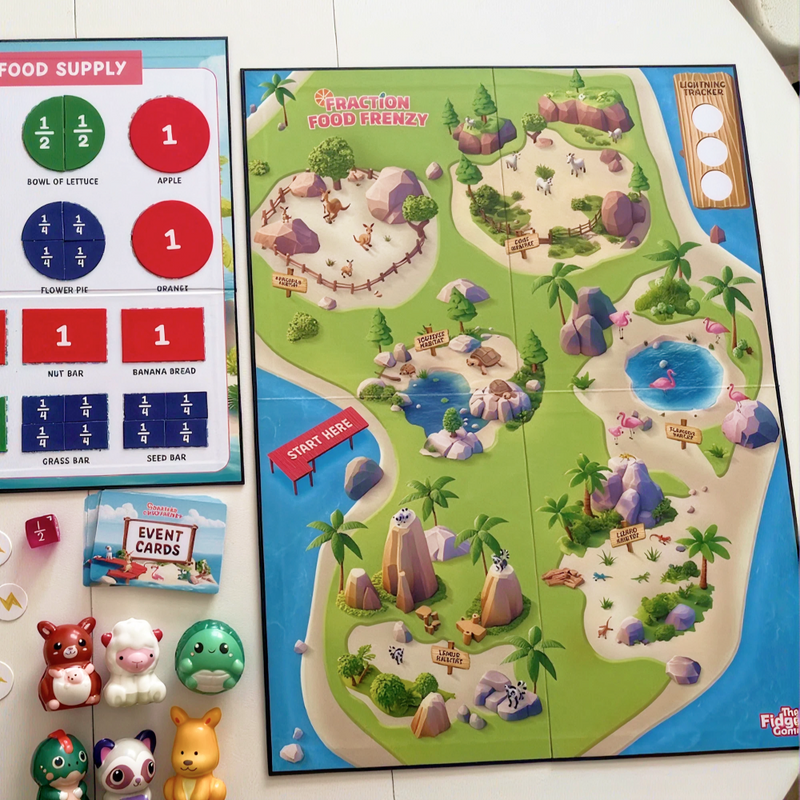
What's Inside The Box
Game Board

Game Board

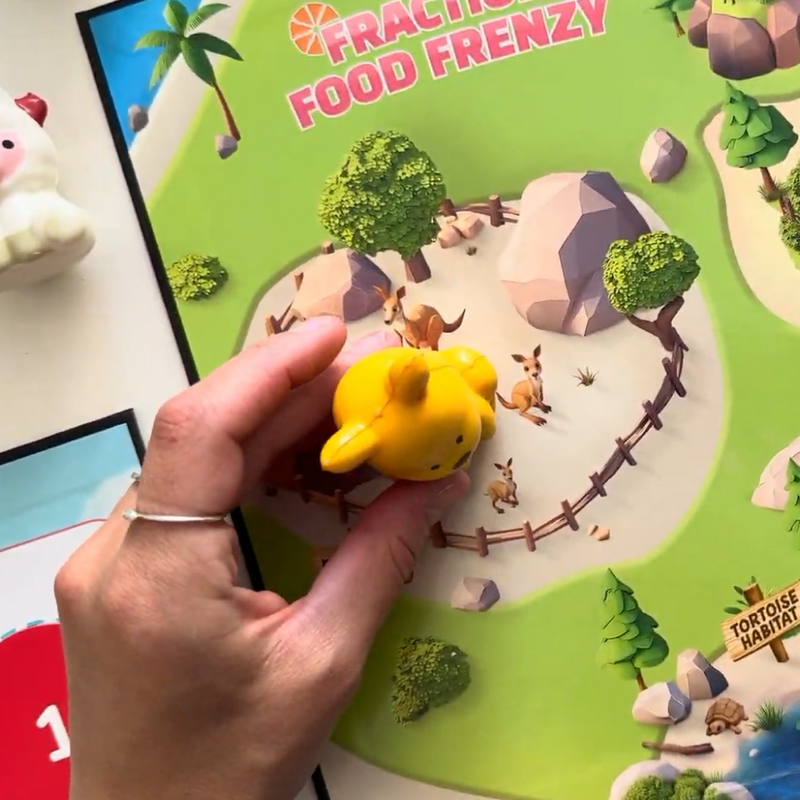
6 Squishy Game Pawns

6 Squishy Game Pawns

Magnetic Food Supply Sheet

Magnetic Food Supply Sheet

6 Animal Food Cards

6 Animal Food Cards

Event Cards

Event Cards

Magnetic Fraction Tiles

Magnetic Fraction Tiles

Instructions

Instructions

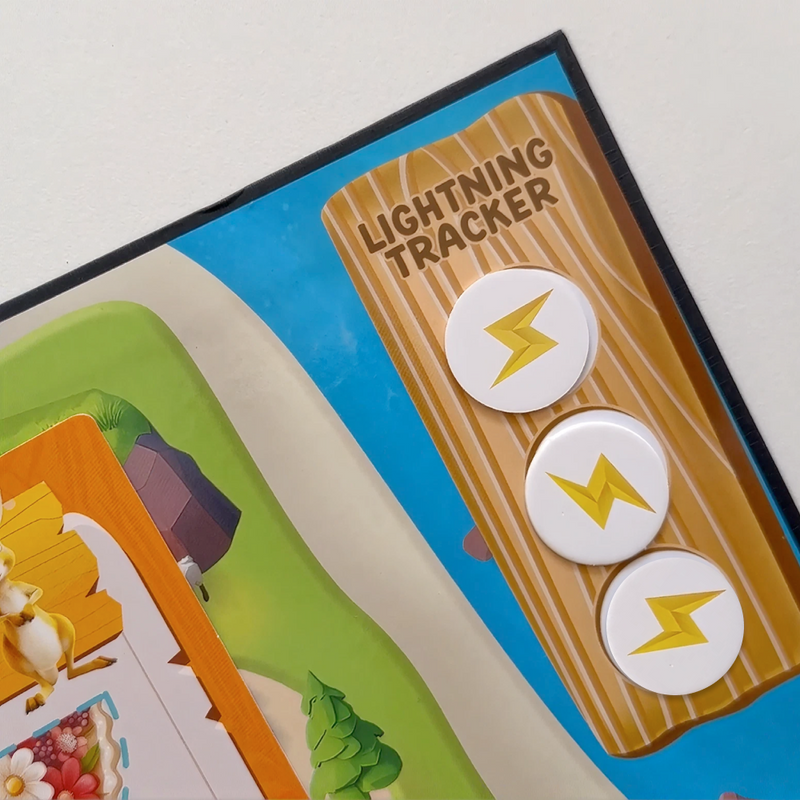
3 Lightning Strikes Token

3 Lightning Strikes Token

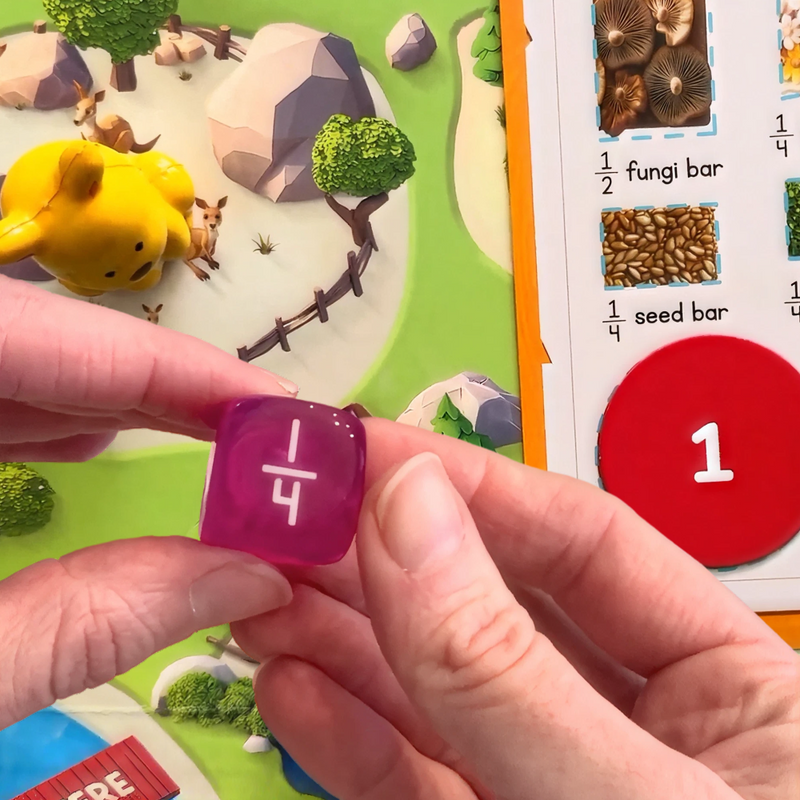
Fraction Die

Fraction Die

Skills Covered After 30 Days
  • Build foundational fraction skills by identifying wholes, halves, fourths, and more
  • Strengthen understanding of part-to-whole relationships using visual models
  • Practice comparing and matching fractions with circles and rectangles
  • Boost real-world math confidence through hands-on fraction play
Key Features
  • 2 to 6 players
  • Ages 6 to 9 (Grades 1 - 3)
  • Quick and Easy Play (15 - 20 min)
Educational Standards
Common Core
  • CCSS.Math.Content.1.G.A.3 Partition circles and rectangles into two and four equal shares, describe the shares using the words halves, fourths, and quarters, and use the phrases half of, fourth of, and quarter of. Describe the whole as two of, or four of the shares. Understand for these examples that decomposing into more equal shares creates smaller shares.
  • CCSS.Math.Content.2.G.A.3 Partition circles and rectangles into two, three, or four equal shares, describe the shares using the words halves, thirds, half of, a third of, etc., and describe the whole as two halves, three thirds, four fourths. Recognize that equal shares of identical wholes need not have the same shape.
  • CCSS.Math.Content.3.G.A.2 Partition shapes into parts with equal areas. Express the area of each part as a unit fraction of the whole. For example, partition a shape into 4 parts with equal area, and describe the area of each part as 1/4 of the area of the shape.
TEKS
  • 2.3C: Use concrete models to count fractional parts beyond one whole using words and recognize how many parts it takes to equal one whole.
  • 2.3B: Explain that the more fractional parts used to make a whole, the smaller the part; and the fewer the fractional parts, the larger the part.
  • 3.3A: Represent fractions greater than zero and less than or equal to one with denominators of 2, 3, 4, 6, and 8 using concrete objects and pictorial models, including strip diagrams and number lines.
  • 3.3C: Explain that the unit fraction 1/b represents the quantity formed by one part of a whole that has been partitioned into b equal parts where b is a non-zero whole number.
  • 3.3E: Solve problems involving partitioning an object or a set of objects among two or more recipients using pictorial representations of fractions with denominators of 2, 3, 4, 6, and 8.
B.E.S.T.
  • MA.1.FR.1.1 Partition circles and rectangles into two and four equal-sized parts. Name the parts of the whole using appropriate language including halves or fourths.
  • MA.2.FR.1.1 Partition circles and rectangles into two, three or four equal-sized parts. Name the parts using appropriate language, and describe the whole as two halves, three thirds or four fourths.
  • MA.2.FR.1.2 Partition rectangles into two, three or four equal-sized parts in two different ways showing that equal-sized parts of the same whole may have different shapes.
  • MA.3.FR.1.1 Represent and interpret unit fractions in the form 1/n as the quantity formed by one part when a whole is partitioned into n equal parts.
Our games are used in 50,000+ classroomsSpecial discounts for school districts and homeschoolers. Get a Quote
View full details
Skills Built

What skills does Fraction Food Frenzy build?

Fractions
Finding equal parts of a whole
30-Day Money Back Guarantee
How to Play

How to play Fraction Food Frenzy

Watch How Fraction Food Frenzy Works

* Results based on internal study with regular users. Individual results may vary.

You ask, we answer!

Is this too hard for a 1st grader / too easy for a 3rd grader?

The fraction die keeps play simple (whole, half, quarter) so 1st graders can succeed, while comparing and combining fractions to fill food cards stretches 2nd–3rd graders. Standards alignment spans all three grades.

What does 'cooperative' mean — is there a winner?

Everyone wins or loses together. Players race the Lightning Tracker, not each other. Great for mixed ages, siblings, and classrooms because it removes the tears that come with competitive losses.

Is it replayable, or will they be bored after three games?

Every game plays out differently — the shuffled event deck changes what challenges and lightning strikes appear (and when), die rolls change what food is available, and players make different travel-vs-roll decisions each time. And because it's cooperative with a real lose condition, wins aren't guaranteed — the "we almost had it, one more game!" factor is built in.

How does this fit in a math block?

At 15–20 minutes for 2–6 players, it slots directly into a math center rotation. It also works as a small-group activity during guided math, an early-finisher option, or a Fun Friday review station. No teacher facilitation required once students know the rules — the game runs itself, which is exactly what a center activity needs.

Does it work for intervention/RTI or students below grade level?

Yes — this is one of its strengths. The die keeps entry-level play simple (whole, half, quarter), students physically build fractions with the magnetic tiles instead of working abstractly, and the cooperative format removes the performance pressure that struggling math students often feel in competitive games. It delivers repeated fraction practice without worksheet fatigue, which is the core of what an intervention block needs.

How does it compare to fraction tiles/manipulatives I already have?

Think of it as manipulatives with a mission. Traditional fraction tiles require a teacher-led activity to be useful — this gives students a self-directed reason to build, compare, and combine fractions. The magnetic tiles snap in place, and the game structure means students get purposeful fraction practice even when you're working with another group.

What makes this different from other fraction games already on the shelf?

Three things: it's cooperative (most fraction games are competitive — this one works for mixed abilities and removes the tears), it's tactile in a way card games aren't (squishy pawns + magnetic fraction tiles), and it was designed by a former elementary teacher with standards printed right on the instruction sheet — CCSS, TEKS, and Florida B.E.S.T., plus Canadian standards via QR.

What is the return policy?

We offer a 30-day return policy for eligible items.