



45 Addition to 10 Cards
Educator CreatedDesigned by teachers
30-day returnshassle-free
Secure paymentsSSL encrypted
Ships in 3 daysfrom the US
Math Ahoy
Math Ahoy
Regular price
$29.99
Sale price
$29.99
Regular price
$34.99
Unit price
per
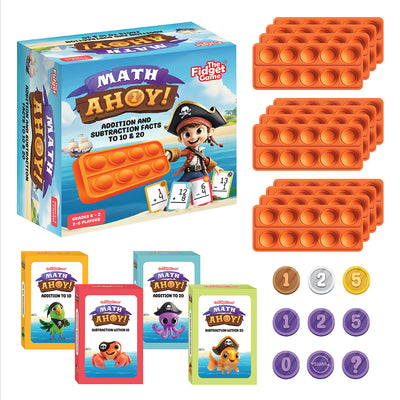
What's Inside The Box
Skills Covered After 30 Days
- Master addition and subtraction facts within 10 and 20
- Reinforce foundational math skills through multi-sensory activities
- Improve fluency, accuracy, and speed with basic operations
Key Features
- Ages 3+
- 2-6 Players (or 1-on-1 fun)
- Quick & Easy Play (10 min)
Educational Standards
Common Core
- CCSS.MATH.CONTENT.K.OA.A.5 Fluently add and subtract within 5.
- CCSS.MATH.CONTENT.K.OA.A.1 Represent addition and subtraction with objects, fingers, mental images, drawings, sounds (e.g., claps), acting out situations, verbal explanations, expressions, or equations.
- CCSS.MATH.CONTENT.1.OA.C.6 Add and subtract within 20, demonstrating fluency for addition and subtraction within 10.
- CCSS.MATH.CONTENT.2.OA.B.2 Fluently add and subtract within 20 using mental strategies.
TEKS
- K.3C: Explain the strategies used to solve problems involving adding and subtracting within 10 using spoken words, concrete and pictorial models, and number sentences.
- 1.3D: Apply basic fact strategies to add and subtract within 20, including making 10 and decomposing a number leading to a 10.
- 2.4A: Recall basic facts to add and subtract within 20 with automaticity.
B.E.S.T
- MA.K.NSO.3.1 Explore addition of two whole numbers from 0 to 10, and related subtraction facts.
- MA.1.NSO.2.1 Recall addition facts with sums to 10 and related subtraction facts with automaticity.
- MA.1.NSO.2.2 Add two whole numbers with sums from 0 to 20, and subtract using related facts with procedural reliability.
- MA.2.NSO.2.1 Recall addition facts with sums to 20 and related subtraction facts with automaticity.
Ontario
- K- OE15 demonstrate an understanding of numbers, using concrete materials to explore and investigate counting, quantity, and number relationships
- Grade 1- B2.2 recall and demonstrate addition facts for numbers up to 10, and related subtraction facts
- Grade 1-B2.3 use mental math strategies, including estimation, to add and subtract whole numbers that add up to no more than 20, and explain the strategies used
- Grade 2- B2.2 recall and demonstrate addition facts for numbers up to 20, and related subtraction facts
BC
- K- number concepts to 10, decomposition of numbers to 10
- Grade 1- addition and subtraction to 20
- Grade 2- addition and subtraction facts to 20 (introduction of computational strategies)
Alberta
- K- Children interpret compositions of quantities within 10.
- Grade 1- Children interpret compositions of quantities within 10.
- Grade 2- Students examine addition and subtraction within 20.
Manitoba
- K.N.4. Represent and describe numbers 2 to 10 in two parts, concretely and pictorially.
- 1.N.9. Demonstrate an understanding of addition of numbers with answers to 20 and their corresponding subtraction facts, concretely, pictorially, and symbolically
- 2.N.10. Apply mental mathematics strategies to develop recall of basic addition facts to 18 and related subtraction facts.
New Brunswick
- K.N4: Represent and describe numbers 2 to 10, concretely and pictorially.
- 1.N9 Demonstrate an understanding of addition of numbers with answers to 20 and their corresponding subtraction facts, concretely, pictorially and symbolically
- 2.N10. Apply mental mathematics strategies to develop recall of basic addition facts to 18 and related subtraction facts.
Newfoundland & Labrador
- SCO KN4 Represent and describe numbers 2 to 10, in two parts, concretely and pictorially.
- SCO 1N8 Demonstrate an understanding of addition of numbers with answers to 20 and their corresponding subtraction facts, concretely, pictorially and symbolically
- SCO 2N10 Apply mental mathematics strategies, for basic addition facts and related subtraction facts to 18.
Nova Scotia
- K.N04 Students will be expected to represent and partition numbers 2 to 10 in two parts, concretely and pictorially.
- 1.N09 Students will be expected to demonstrate an understanding of the addition of two one-digit numbers and the corresponding subtraction, concretely, pictorially, and symbolically, in join, separate, equalize/compare, and part-part-whole situations.
- 2.N10 Students will be expected to apply mental mathematics strategies to quickly recall basic addition facts to 18 and determine related subtraction facts
Prince Edward Island
- K.1.5 show a given number as two parts concretely and name the two parts (2 to 10)
- 1.N8 – Demonstrate an understanding of addition of numbers with answers to 20 and their corresponding subtraction facts, concretely, pictorially and symbolically
- 2.N10 – Apply mental mathematics strategies to determine basic addition facts to 18 and related subtraction facts.
Saskatchewan
- NK.4 Represent the partitioning of whole numbers (1 to 10) concretely and pictorially.
- N1.9 Demonstrate an understanding of addition of numbers with answers to 20 and the corresponding subtraction facts, concretely, pictorially, physically, and symbolically
Our games are used in 50,000+ classroomsSpecial discounts for school districts and homeschoolers.
Get a Quote


Families Who Have Already Made Math Fun
4.81
Skills Built
What skills does Math Ahoy build?
Addition & Subtraction
Adding and taking away quantities
30-Day Money Back Guarantee
How to Play
How to play Math Ahoy
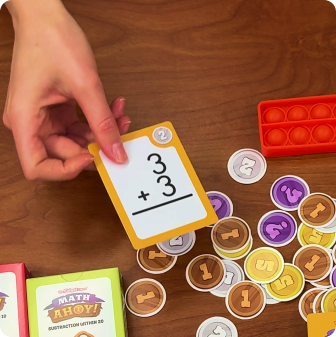
1
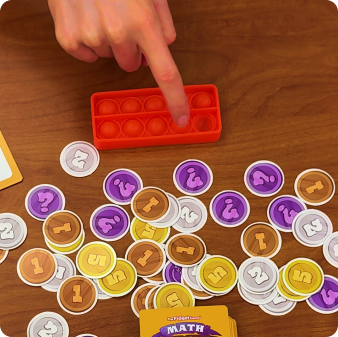
Choose a card and answer the fact.
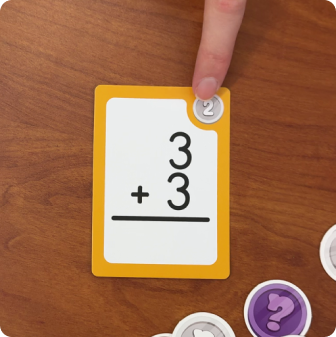
2
If correct, take the matching coin.
3
Collect the most points to win!
Watch How Math Ahoy Works


* Results based on internal study with regular users. Individual results may vary.
You ask, we answer!
What is the return policy?
We offer a 30-day return policy for eligible items.