



3 Multiplication Card Packs
Educator CreatedDesigned by teachers
30-day returnshassle-free
Secure paymentsSSL encrypted
Ships in 3 daysfrom the US
Number Ninja
Number Ninja
Regular price
$29.99
Sale price
$29.99
Regular price
$34.99
Unit price
per
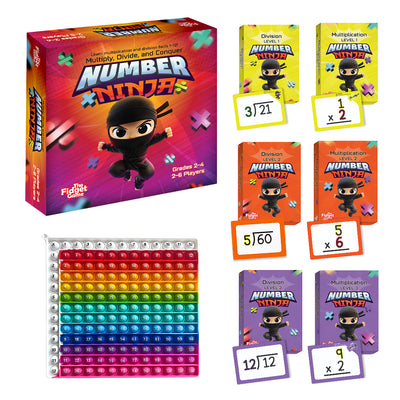
What's Inside The Box
Skills Covered After 30 Days
- Master core multiplication and division facts
- Strengthen mental math and problem-solving speed
- Increase confidence when approaching math challenges
- Build readiness for higher-level math, including multi-step operations and word problems
Key Features
- Ages 6+
- 2-4 Players (or 1-on-1 fun)
- Quick & Easy Play (10 min)
Educational Standards
Common Core
- 2.OA.4 Work with equal groups of objects to gain foundations for multiplication.
- 3.OA.7 Multiply and divide within 100.
- 4.OA.1 Interpret a multiplication equation as a comparison
TEKS
- 2.6: The student applies mathematical process standards to connect repeated addition and subtraction to multiplication and division situations that involve equal groupings and shares.
- 3.4F: Recall facts to multiply up to 10 by 10 with automaticity and recall the corresponding division facts.
- 3.4K: Solve one-step and two-step problems involving multiplication and division within 100 using strategies based on objects; pictorial models, including arrays, area models, and equal groups; properties of operations; or recall of facts.
- 4.4H: Solve with fluency one- and two-step problems involving multiplication and division, including interpreting remainders.
B.E.S.T.
- MA.2.AR.3 Develop an understanding of multiplication.
- MA.3.AR.1 Solve multiplication and division problems.
- MA.4.AR.1 Represent and solve problems involving the four operations with whole numbers and fractions.
Ontario
- Grade 3- B2.2 recall and demonstrate multiplication facts of 2, 5, and 10, and related division facts
- Grade 4- B2.2 recall and demonstrate multiplication facts for 1 × 1 to 10 × 10, and related division facts
- Grade 4- B2.6 represent and solve problems involving the division of two- or three-digit whole numbers by one-digit whole numbers, expressing any remainder as a fraction when appropriate, using appropriate tools, including arrays
- Grade 5- B2.2 recall and demonstrate multiplication facts from 0 × 0 to 12 × 12, and related division facts
BC
- Grade 3- multiplication and division concepts
- Grade 4- multiplication and division of two- or three-digit
- numbers by one-digit numbers
- Grade 5- multiplication and division facts to 100 (emerging computational fluency)
Alberta
- Grade 3- Students analyze and apply strategies for multiplication and division within 100.
- Grade 4- Students multiply and divide natural numbers within 10 000.
- Grade 5- Students multiply and divide natural numbers within 100 000, including with standard algorithms.
Manitoba
- Grade 3- 3.N.11. Demonstrate an understanding of multiplication to 5 x 5
- Grade 3- 3.N.12. Demonstrate an understanding of division
- Grade 4- 4.N.6 Demonstrate an understanding of multiplication (2- or 3-digit numerals by 1-digit numerals) to solve problems
- Grade 4- 4.N.7 Demonstrate an understanding of division(1-digit divisor and up to 2-digit dividend) to solve problems
- Grade 5- 5.N.3 Apply mental math strategies to determine multiplication and related division facts to 81 (9 × 9).
- Grade 5- 5.N.6 Demonstrate an understanding of division (1- and 2-digit divisors and up to 4-digit dividends), concretely, pictorially, and symbolically, and interpret remainders
- Grade 5- 5.N.5 Demonstrate an understanding of multiplication (1- and 2-digit multipliers and up to 4-digit multiplicands), concretely, pictorially, and symbolically
New Brunswick
- Grade 3- N11 Demonstrate an understanding of multiplication to 5 × 5
- Grade 3- N12 Demonstrate an understanding of division
- Grade 4- N6 Demonstrate an understanding of multiplication (2- or 3-digit by 1-digit) to solve problems
- Grade 4- N7 Demonstrate an understanding of division (1-digit divisor and up to 2-digit dividend) to solve problems
- Grade 5- Apply mental math strategies to determine multiplication and related division facts to 81 (9 × 9).
- Grade 5- Demonstrate an understanding of multiplication (2-digit by 2-digit) to solve problems
- Grade 5- Demonstrate, with and without concrete materials, an understanding of division (3-digit by 1-digit) and interpret remainders to solve problems
Newfoundland & Labrador
- Grade 3- SCO 3N11 Demonstrate an understanding of multiplication to 5 × 5
- Grade 3- SCO 3N12 Demonstrate an understanding of division (limited to division related to multiplication facts up to 5 × 5)
- Grade 4- 4N6. Demonstrate an understanding of multiplication (two- or three-digit by one-digit) to solve problems
- Grade 4- 4N7. Demonstrate an understanding of division (one digit divisor and up to two-digit dividend) to solve problems
- Grade 5- Apply mental math strategies to determine multiplication and related division facts to 81 (9 × 9).
- Grade 5- SCO 5N5 Demonstrate, with and without concrete materials, an understanding of multiplication (two-digit by two-digit) to solve problems.
- Grade 5- SCO 5N6 Demonstrate, with and without concrete materials, an understanding of division (three-digit by one-digit), and interpret remainders to solve problems.
Nova Scotia
- Grade 3- N11 Students will be expected to demonstrate an understanding of multiplication to 5 × 5
- Grade 3- N12 Students will be expected to demonstrate an understanding of division
- Grade 4- N06 Students will be expected to demonstrate an understanding of multiplication (one-, two-, or three-digit by one-digit numerals) to solve problems
- Grade 4- N05 Students will be expected to describe and apply mental mathematics strategies, to recall basic multiplication facts to 9 × 9, and to determine related division facts.
- Grade 4- N07 Students will be expected to demonstrate an understanding of division (one-digit divisor and up to two-digit dividend) to solve problems
- Grade 5- N03 Students will be expected to describe and apply mental mathematics strategies and number properties to recall, with fluency, answers for basic multiplication facts to 81 and related division facts.
- Grade 5- N05 Students will be expected to demonstrate, with and without concrete materials, an understanding of multiplication (two-digit by two-digit) to solve problems
- Grade 5- N06 Students will be expected to demonstrate, with and without concrete materials, an understanding of division (three-digit by one-digit), and interpret remainders to solve problems.
Prince Edward Island
- Grade 3- 3.N10 – Demonstrate an understanding of multiplication to products of 36 with single digit factors.
- Grade 3- 3.N11 – Demonstrate an understanding of division (related multiplication to products of 36 with single digit factors).
- Grade 4- 4.N5 Students will be expected to describe and apply mental mathematics strategies, to recall basic multiplication facts to 9 × 9, and to determine related division facts.
- Grade 4- 4.N6 Demonstrate an understanding of multiplication (2- or 3-digit by 1-digit) to solve problems.
- Grade 4- 4.N7 Demonstrate an understanding of division (1- digit divisor and up to 2-digit dividend) to solve problems.
- Grade 5- 5.N3 Apply mental mathematics strategies and number properties, such as skip counting from a known fact, using doubling or halving, using patterns in the 9s facts, and using repeated doubling or halving to determine answers for basic multiplication facts to 81 and related division facts.
- Grade 5- 5.N5 – Demonstrate an understanding of multiplication (2-digit by 2-digit) to solve problems.
- Grade 5- 5.N6 – Demonstrate, with and without concrete materials, an understanding of division (3- digit by 1-digit) and interpret remainders to solve problems.
Saskatchewan
- Grade 3- N3.3 Demonstrate understanding of multiplication to 5 x 5 and the corresponding division statements
- Grade 4- N4.4 Demonstrate an understanding of multiplication (2- or 3-digit by 1-digit)
- Grade 4- N4.5 Demonstrate an understanding of division (1-digit divisor and up to 2-digit dividend) to solve problems
- Grade 5- N5.3 Demonstrate, with and without concrete materials, an understanding of division (3-digit by 1-digit) and interpret remainders to solve problems.
- Grade 5- N5.2 Analyze models of, develop strategies for, and carry out multiplication of whole numbers.
Our games are used in 50,000+ classroomsSpecial discounts for school districts and homeschoolers.
Get a Quote


Families Who Have Already Made Math Fun
4.8
Skills Built
What skills does Number Ninja build?
Multiplication and Division
Making equal groups and sharing them out equally
30-Day Money Back Guarantee
How to Play
How to play Number Ninja
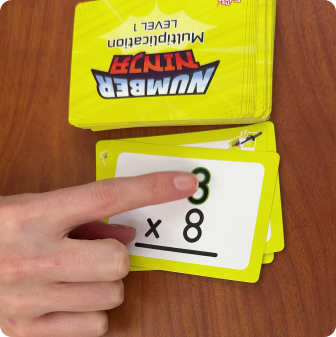
1
Choose a card and answer the fact.
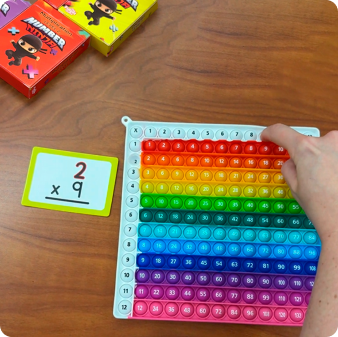
2
If correct, play the card.
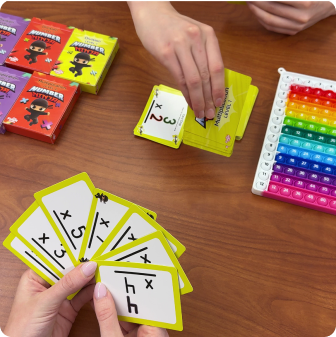
3
If unsure, use the Multiply and Divide Fidget Mat.
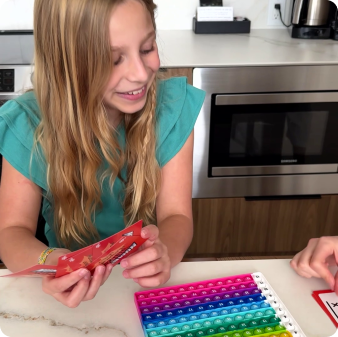
4
Whoever gets rid of their cards first, wins!
Watch How Number Ninja Works


* Results based on internal study with regular users. Individual results may vary.
You ask, we answer!
What is the return policy?
We offer a 30-day return policy for eligible items.