


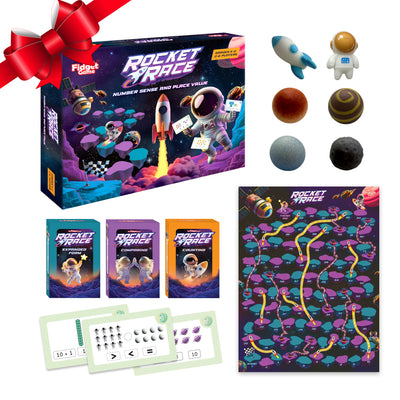


1 Game Board
Educator CreatedDesigned by teachers
30-day returnshassle-free
Secure paymentsSSL encrypted
Ships in 3 daysfrom the US
Rocket Race
Rocket Race
Regular price
$29.99
Sale price
$29.99
Regular price
$34.99
Unit price
per
What's Inside The Box
Expected Results After 30 Days
- Build number sense by exploring numbers in standard, expanded, and picture forms
- Develop a strong understanding of place value from ones to hundreds
- Strengthen comparison skills using greater than, less than, and equal to
- Boost math confidence
- Encourage strategic thinking and problem-solving
Key Features
- Ages 3+
- 2-6 Players (or 1-on-1 fun)
- Quick & Easy Play (10 min)
Educational Standards
Common Core
- CCSS.Math.Content.K.CC.B.4 Understand the relationship between numbers and quantities; connect counting to cardinality.
- CCSS.Math.Content.K.CC.C.6 Identify whether the number of objects in one group is greater than, less than, or equal to the number of objects in another group.
- CCSS.Math.Content.K.CC.C.7 Compare two numbers between 1 and 10 presented as written numerals.
- CCSS.Math.Content.K.NBT.A.1 Compose and decompose numbers from 11 to 19 into ten ones and some further ones, e.g., by using objects or drawings, and record each composition or decomposition by a drawing or equation (such as 18 = 10 + 8); understand that these numbers are composed of ten ones and one, two, three, four, five, six, seven, eight, or nine ones.
- CCSS.Math.Content.1.NBT.B.2 Understand that the two digits of a two-digit number represent amounts of tens and ones.
- CCSS.Math.Content.1.NBT.B.3 Compare two two-digit numbers based on meanings of the tens and ones digits, recording the results of comparisons with the symbols >, =, and <.
- CCSS.Math.Content.2.NBT.A.1 Understand that the three digits of a three-digit number represent amounts of hundreds, tens, and ones; e.g., 706 equals 7 hundreds, 0 tens, and 6 ones.
- CCSS.Math.Content.2.NBT.A.4 Compare two three-digit numbers based on meanings of the hundreds, tens, and ones digits, using >, =, and < symbols to record the results of comparisons.
- CCSS.Math.Content.2.NBT.A.3 Read and write numbers to 1000 using base-ten numerals, number names, and expanded form.
TEKS
- K.2C: Count a set of objects up to at least 20 and demonstrate that the last number said tells the number of objects in the set regardless of their arrangement or order.
- K.2G: Compare sets of objects up to at least 20 in each set using comparative language.
- K.2H: Use comparative language to describe two numbers up to 20 presented as written numerals.
- 1.2B: Use concrete and pictorial models to compose and decompose numbers up to 120 in more than one way as so many hundreds, so many tens, and so many ones.
- 1.2C: Use objects, pictures, and expanded and standard forms to represent numbers up to 120.
- 1.2E: Use place value to compare whole numbers up to 120 using comparative language.
- 1.2G: Represent the comparison of two numbers to 100 using the symbols >, <, or =.
- 2.2A: Use concrete and pictorial models to compose and decompose numbers up to 1,200 in more than one way as a sum of so many thousands, hundreds, tens, and ones.
- 2.2B: Use standard, word, and expanded forms to represent numbers up to 1,200.
- 2.2D: Use place value to compare and order whole numbers up to 1,200 using comparative language, numbers, and symbols (>, <, or =).
B.E.S.T.
- MA.K.NSO.1.1 Given a group of up to 20 objects, count the number of objects in that group and represent the number of objects with a written numeral.
- MA.K.NSO.1.4 Compare the number of objects from 0 to 20 in two groups using the terms less than, equal to or greater than.
- MA.K.NSO.2.3 Locate, order and compare numbers from 0 to 20 using the number line and terms less than, equal to or greater than.
- MA.K.NSO.2.2 Represent whole numbers from 10 to 20, using a unit of ten and a group of ones, with objects, drawings and expressions or equations.
- MA.1.NSO.1.2 Read numbers from 0 to 100 written in standard form, expanded form and word form. Write numbers from 0 to 100 using standard form and expanded form.
- MA.1.NSO.1.3 Compose and decompose two-digit numbers in multiple ways using tens and ones. Demonstrate each composition or decomposition with objects, drawings and expressions or equations.
- MA.1.NSO.1.4 Plot, order and compare whole numbers up to 100.
- MA.2.NSO.1.2 Compose and decompose three-digit numbers in multiple ways using hundreds, tens and ones. Demonstrate each composition or decomposition with objects, drawings and expressions or equations.
- MA.2.NSO.1.3 Plot, order and compare whole numbers up to 1,000.
Ontario
- K- OE15. demonstrate an understanding of numbers, using concrete materials to explore and investigate counting, quantity, and number relationships
- 1-B1.3 compare and order whole numbers up to and including 50, in various contexts
- 1-B1.2 compose and decompose whole numbers up to and including 50, using a variety of tools and strategies, in various contexts
- 2-B1.2 compare and order whole numbers up to and including 200, in various contexts
- 2-B1.1 read, represent, compose, and decompose whole numbers up to and including 200, using a variety of tools and strategies, and describe various ways they are used in everyday life
British Columbia
- K- number concepts to 10
- Grade 1- number concepts to 20
- Grade 2- number concepts to 100
- Alberta
- K- Children investigate quantity to 10.
- Grade 1- Students interpret and explain quantity to 100.
- Grade 2- Students analyze quantity to 1000.
Manitoba
- K.N.2. Subitize and name familiar arrangements of 1 to 6 dots (or objects).
- K.N.5. Demonstrate an understanding of counting to 10
- K.N.6. Compare quantities, 1 to 10
- 1.N.2. Subitize and name familiar arrangements of 1 to 10 dots (or objects).
- 1.N.5. Compare and order sets containing up to 20 elements to solve problems
- 2.N.4. Represent and describe numbers to 100, concretely, pictorially, and symbolically.
- 2.N.5. Compare and order numbers up to 100.
New Brunswick
- K- SCO: N1: Say the number sequence by 1s starting anywhere from 1 to 10 and from 10 to 1.
- K- SCO: N2: Recognize, at a glance, and name familiar arrangements of 1 to 5 objects or dots
- K- SCO: N3: Relate a numeral, 1 to 10, to its respective quantity.
- K- SCO: N4: Represent and describe numbers 2 to 10, concretely and pictorially
- K- SCO: N5: Compare quantities, 1 to 10, using one-to-one correspondence
- Grade 1- SCO: N2: Recognize, at a glance, and name familiar arrangements of 1 to 10 objects or dots
- Grade 1- SCO: N3: Demonstrate an understanding of counting
- Grade 1- N5: Compare sets containing up to 20 elements to solve problems
- Grade 2- SCO: N5: Compare and order numbers up to 100.
- Grade 2- SCO: N4: Represent and describe numbers to 100, concretely, pictorially and symbolically.
Newfoundland & Labrador
- KN3. Relate a numeral, 1 to 10, to its respective quantity.
- 1N3: Demonstrate an understanding of counting
- 1N5: Compare sets containing up to 20 elements to solve problems
- 2N5: Compare and order numbers up to 100.
- 2N4: Represent and describe numbers to 100, concretely, pictorially and symbolically.
Nova Scotia
- KN03. Relate a numeral, 1 to 10, to its respective quantity.
- 1N03 Students will be expected to demonstrate an understanding of counting to 20
- 1N05 Students will be expected to compare sets containing up to 20 objects to solve problems
- 2N05: Compare and order numbers up to 100.
- 2N04: Represent and describe numbers to 100, concretely, pictorially and symbolically.
Prince Edward Island
- K.1.1 count in a variety of ways
- K.1.2 explore a variety of physical representations of numbers 1 to 10
- K.1.3 count to determine the number in a group (0 to 10)
- K.1.6 determine which group has more, which group has less, or which are equivalent
- 1.N2 – Recognize, at a glance, and name familiar arrangements of 1 to 10 objects or dots.
- 1.N3 – Demonstrate an understanding of counting by indicating that the last number said identifies “how many”; showing that any set has only one count; using the counting on strategy; and using parts or equal groups to count sets.
- 1.N5 – Compare sets containing up to 20 elements to solve problems using: referents; and one-to-one correspondence.
- 2.N4 – Represent and describe numbers to 100, concretely, pictorially and symbolically.
- 2.N5 – Compare and order numbers up to 100.
Saskatchewan
- NK.3 Relate a numeral, 0 to 10, to its respective quantity.
- NK.5 Compare quantities, 0 to 10, using one-to-one correspondence
- N1.3 Demonstrate an understanding of counting
- N1.4 Represent and describe whole numbers to 20 concretely, pictorially, and symbolically
- N1.5 Compare sets containing up to 20 elements to solve problems
- N2.1 Demonstrate understanding of whole numbers to 100 (concretely, pictorially, physically, orally, in writing, and symbolically)
Our games are used in 50,000+ classroomsSpecial discounts for school districts and homeschoolers.
Get a Quote


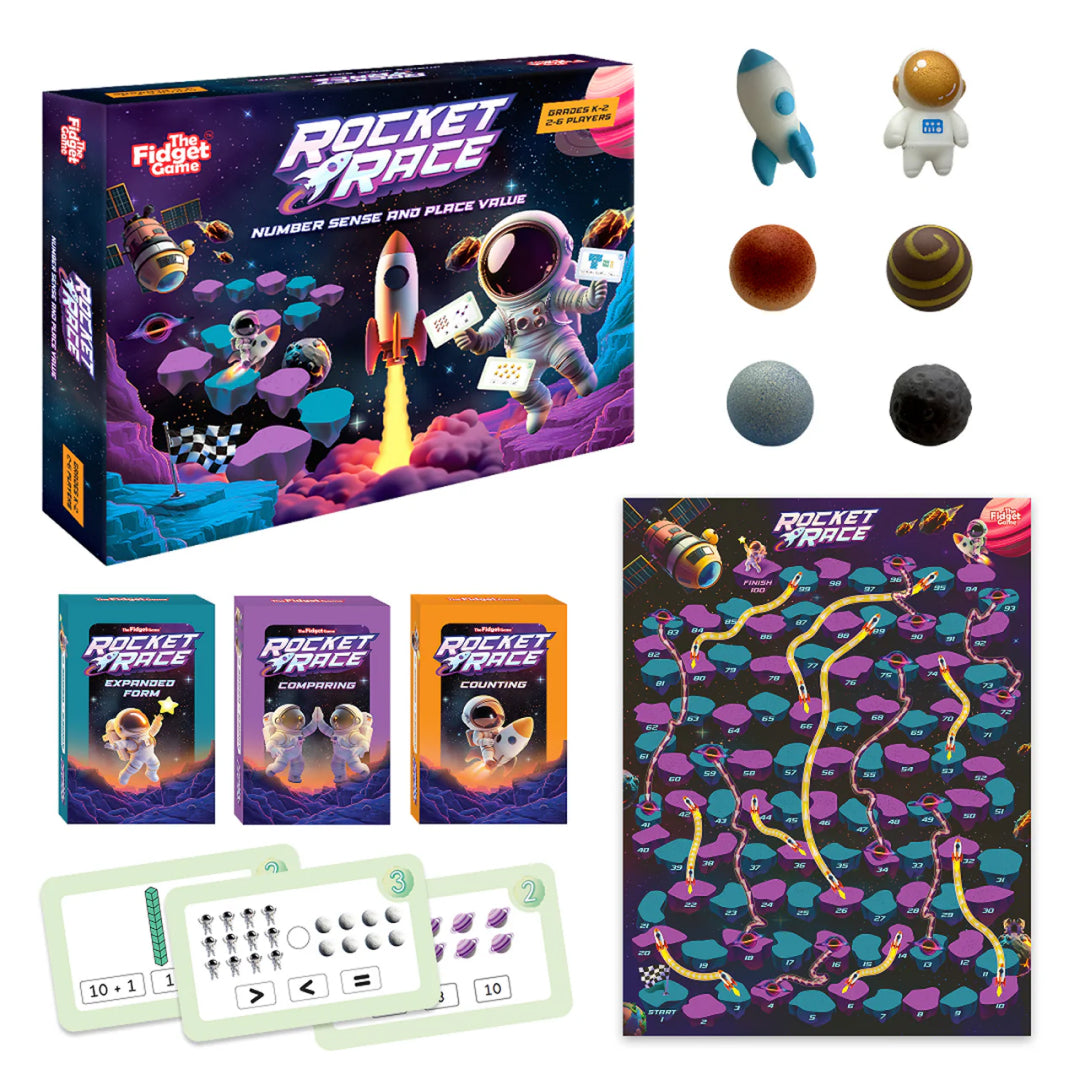
Families Who Have Already Made Math Fun
4.8
Skills Built
What skills does Rocket Race build?
Numbers
Counting and recognizing numbers
Place Value
Tens, ones & understanding bigger numbers
30-Day Money Back Guarantee
How to Play
How to play Rocket Race

1
Choose a card and solve.

2
If correct, move your pawn the number of spaces shown

3
Reach space #100 to win!
Watch How Rocket Race Works


* Results based on internal study with regular users. Individual results may vary.
You ask, we answer!
What is the return policy?
We offer a 30-day return policy for eligible items.