


Educator CreatedDesigned by teachers
30-day returnshassle-free
Secure paymentsSSL encrypted
Ships in 3 daysfrom the US
Word Pop! - Buy 1 Get 1, 50% Off
Word Pop! - Buy 1 Get 1, 50% Off
Regular price
$45.00
Sale price
$45.00
Regular price
$69.99
Unit price
per
Skills Covered After 30 Days
- Learn letter sound blending
- Master CVC words
- Increase word recognition
- Improve fluency
Key Features
- Ages 5-7 (Kindergarten to Grade 1)
- 2-4 Players (or 1-on-1 Fun)
- Quick & Easy Play (15 min)
What’s Inside Each Game Box
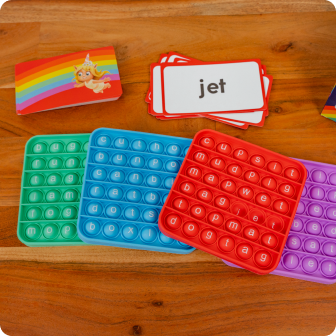
- 4 Double-Sided Fidget Letter Mats
- 50 CVC Word Cards
- 1 Learning Guide (Downloadable PDF)
- 1 Instruction Guide
Educational Standards
Common core
- CCSS.ELA-LITERACY.RF.K.2.D Isolate and pronounce the initial, medial vowel, and final sounds (phonemes) in three-phoneme (consonant-vowel-consonant, or CVC) words.
- CCSS.ELA-LITERACY.RF.K.3.A Demonstrate basic knowledge of one-to-one letter-sound correspondences by producing the primary sound or many of the most frequent sounds for each consonant.
- CCSS.ELA-LITERACY.RF.1.2.C Isolate and pronounce initial, medial vowel, and final sounds (phonemes) in spoken single-syllable words.
TEKS
- K.2B.ii: using letter-sound relationships to decode, including VC, CVC, CCVC, and CVCC words;
- 1.2B.i: decoding words in isolation and in context by applying common letter sound correspondences;
B.E.S.T
- ELA.K.F.1.3.c Decode consonant-vowel-consonant (CVC) words.
- ELA.1.F.1.3 Decode and encode regularly spelled one-syllable words.
Ontario
- K- OE1.1 explore sounds, rhythms, and language structures, with guidance and on their own
- K-OE1.11 demonstrate an awareness that words can rhyme, can begin or end with the same sound, and are composed of phonemes that can be manipulated to create new words
- K- OE11.8 demonstrate knowledge of most letters of the alphabet in different contexts
- Grade 1- B2.3 identify, read, and spell most common grapheme-phoneme correspondences of consonants and vowels, with automaticity
- Grade 1- B2.4 use phonics knowledge and phonemic blending to read words, and phonemic segmentation to spell phonetically regular words, in isolation and various text contexts
BC
- K- Language features, structures, and conventions: concepts of print, letter knowledge, phonemic and phonological awareness, letter formation
- Grade 1- Language features, structures, and conventions: concepts of print, print awareness, phonemic and phonological awareness, letter formation
Alberta
- K- Children make connections between letters and sounds in words.
- K- Children experiment with sounds in words.
- K- Children recognize some letters and words with speed and accuracy.
- Grade 1- Students recognize and analyze letters and sounds in words.
- Grade 1- Students apply accuracy, appropriate rate, and expression in the development of fluency.
Manitoba
- K- Recognize, apply, and adapt rules and conventions (e.g., form, genre, grammar, register, punctuation, elements of design, spelling, legibility).
- K- Identify, analyze, and apply understandings of whole-part-whole relationships (e.g., function and relationship of parts within a whole design, cueing systems, fluency, word study).
- Grade 1- Recognize, apply, and adapt rules and conventions (e.g., form, genre, grammar, register, punctuation, elements of design, spelling, legibility).
- Grade 1- Identify, analyze, and apply understandings of whole-part-whole relationships (e.g., function and relationship of parts within a whole design, cueing systems, fluency, word study).
New Brunswick
- K- Apply letter-sound knowledge to decode words and simple connected text.
- Grade 1- Apply letter-sound knowledge to decode words and connected text.
Newfoundland & Labrador
- K- GCO 4: Students will be expected to select, read, and view with understanding a range of literature, information, media, and visual texts. 4.3 use strategies to make sense of texts 4.5 demonstrate letter knowledge.
- Grade 1- GCO 4: Students will be expected to select, read, and view with understanding a range of literature, information, media, and visual texts.4.3 use strategies to make sense of texts
Nova Scotia
- K- Use phonics knowledge and phonemic blending to read words in isolation and various text contexts.
- K- Use phonemic segmentation to spell phonetically regular words, in isolation and various text contexts.
- Grade 1- Use phonics knowledge and phonemic blending to read words in isolation and various text contexts.
- Grade 1- Use phonemic segmentation to spell phonetically regular words, in isolation and various text contexts.
Prince Edward Island
- K- understand basic concepts of print including directionality, word, space, letter, and sound
- K- begin to use knowledge of sound-symbol relationships as one reading cue (e.g., initial and final consonants)
- Grade 1- understand basic concepts of print including directionality, word, space, letter, and sound
- Grade 1- begin to use knowledge of sound-symbol relationships as one reading cue (e.g., initial and final consonants)
Saskatchewan
- K- CCK.2 Use and construct symbols, pictures, and dramatizations to communicate feelings and ideas in a variety of ways.
- Grade 1- CC1.2 Represent key ideas and events, in a logical sequence and with detail, in different ways (including dramatization, pictures, sounds, physical movement, charts, models, and drawings).
- Understand sound–symbol relationships and recognize familiar sounds/symbols/ words of the language community
- Understand sound–symbol relationships and apply reliable phonetic strategies when decoding print
Our games are used in 50,000+ classroomsSpecial discounts for school districts and homeschoolers.
Get a Quote


Families Who Have Already Learned to Read
Skills Built
What skills does Word Pop! - Buy 1 Get 1, 50% Off build?
Phonics
Connecting sounds to written letters
Blends
Combining consonant sounds together
30-Day Money Back Guarantee
How to Play
How to play Word Pop! - Buy 1 Get 1, 50% Off
1
Grab your fidget mat.
2
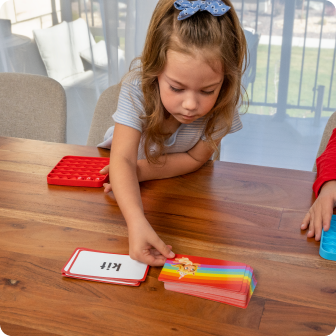
Choose a card and find the word.
3
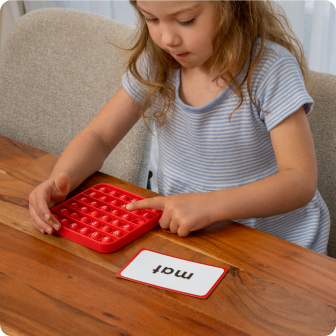
Pop the bubble as you sound out the word.
4
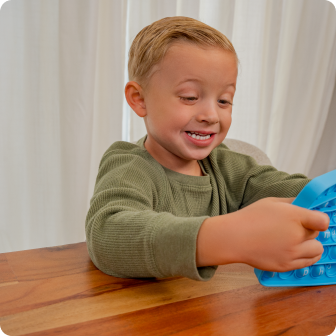
First one to pop all their bubbles wins! 🎉
Watch How Word Pop! - Buy 1 Get 1, 50% Off Works


* Results based on internal study with regular users. Individual results may vary.
You ask, we answer!
What is the return policy?
We offer a 30-day return policy for eligible items.